Wednesday, April 27, 2016

Student Mark Scanners

In the beginning all student mark data were entered manually. Then card readers came. Then optical scanners. Now student mark data are collected on the Internet. Not having an answer sheet or card changes the testing.

Now a student must answer each question as it is presented. There is a loss of control. There is no time to think about it and to return to make a choice. There are no balls in the game; only strikes and outs. It speeds up the game but is another way of reducing judgment.


The student with the quickest response wins. Time for use of higher levels of thinking is reduced. Online and paper tests are measuring different things and at different levels of thinking using forced-choice traditional scoring.



Wednesday, April 20, 2016

Multiple-Choice Rosetta Stone

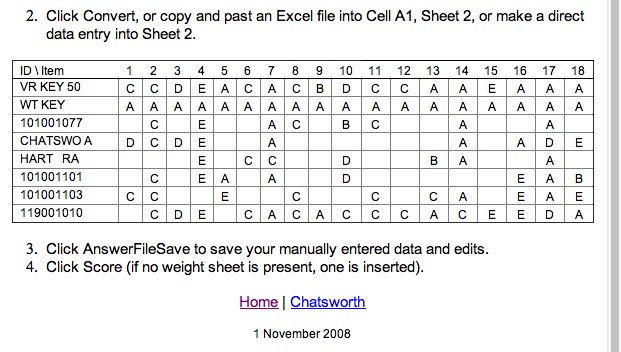
The process of setting standardized test scores in the past has been as much politics and money as it has been effective assessment for student, teacher and test development. Power Up Plus contained features that managed cheating as well as compared classroom designed tests with Item response theory (IRT) tests used by state departments of education (where cheating could be as common as in the classroom).


A number of these features were of interest in auditing the Rasch IRT model that took a very liberal view of student mark data. It provided the basis for several states to obtain amazing annual yearly improvement results. 


Wednesday, April 13, 2016

Marking and the Effective Teacher

Marking, scoring, and grading are as simple for knowledge and judgment scoring as for traditional right mark scoring with one big difference: guessing is not required. If a student choose to mark all answers, the test automatically returned to traditional forced-choice testing when Power Up Plus was used.


Wednesday, April 6, 2016

Multiple-Choice Test Scoring Methods

Valid cut scores have been set from over 70% to 35% on standardized tests. The traditional DUMB scores of A, 90%; B, 80%; C, 70%, D, 60%, and F, 50% and below are easily achieved by adjusting question difficulty. This common practice is rarely questioned. The main interest is the number of right marks.


On the other hand, any set of questions can be used, scored, and cut scores set from a classroom friendly item analysis. Now student quality, as well as quantity, is of interest. The value of right marks is independent from the number of right marks (all 20 marks out of 30 is 100% right; 67% right count; no wrong marks. This student has a solid basis for further learning by whatever means of instruction). Neither the student nor the teacher needs to guess about what has yet to be learned.


Wednesday, March 30, 2016

Power Up Plus (PUP)

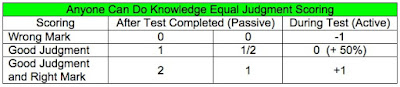
Anyone can do knowledge and judgment scoring. Instead of just counting right marks, you value knowledge and judgement equally:


Power Up PLus did this. It still provides a full set of examples of quantity and quality printouts for grades, student counseling, item development, and course development. 

High quality students get high test scores. The power of knowledge and judgment scoring to develop active self-correcting high achieving students is still needed in 2016 as is has been for the past three decades. 

The emphasis was and still needs to be on student development, not on the highest standardized test score. The learning environment must include all levels of thinking, not just   lower level of thinking test coaching for the big test.

This blog returns to the days when teachers made their own multiple-choice questions; before they could select questions on line from test banks that were calibrated to guess-tested standardized tests (academic Family Feud).

Teacher created tests use a common vocabulary actually used in their classrooms. This adds about a 10% increase in the average test score in relation to foreign generated questions.
2013 Landing Page

Power Up Plus version 5.22 was the last edition that combines DUMB TESTING and SMART TESTING. Students can elect the level of thinking they are the most comfortable with as they develop from negative rote memorizers to highly successful positive self-instructing students.


Tuesday, March 29, 2016

Copy Detector - KJS


The copy detector has more information to work with using knowledge and judgment  scoring (KJS) than with right mark scoring (RMS). Now Omit is a mark rather than an error in a guessing game.

There is no distinct break in the beginning of the pairing index and at the end of the pairing count plots to confirm cheating on this test.

The two most suspect answer sheets have a string of 26 identical marks. That does not occur on the four reference pairs. This becomes presumed cheating if this high a score was not characteristic of one of these two students.

Confirmation requires a repeat of this magnitude or a classroom observation during the next test. A repeat performance while in a secure environment would reject presumed cheating.